
There are bacteria living on all surfaces of our bodies inside and out. However, our gut contains the most at over 100 trillion cells. These beneficial bacteria which live primarily in the large intestine are called our microbiota or what is now referred to as the microbiome. They perform a number of important tasks that help keep us healthy. In order for them to do their job we need to do our part to ensure a thriving and robust gut bacterial population.
The microbiome has been implicated to be involved in many aspects of our health. So far scientists have shown correlations between the microbiome and certain diseases, but more research is needed to prove that changes in gut bacterial populations cause or prevent certain health related issues. However, there are a number of roles the microbiome carries out for which there is substantial evidence. For example, they produce essential vitamins such as Vitamin B6, Folate, Biotin, Thiamine, Vitamin K, and Riboflavin. In addition, they are involved in host defense mechanisms by producing chemicals during the fermentation process that help to strengthen the immune system and decrease inflammation. Also, by occupying space in our gut they help us to avoid harmful bacteria from taking up residence. Although these tasks are important to our health there is a function they perform that is impacted directly by our food choices. Our microbiome has the ability to digest carbohydrates that we can’t.
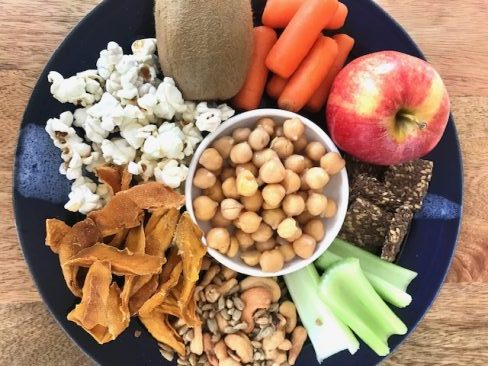
Complex carbohydrates are the microbiomes preferred fuel source. In fact, a high fiber diet is thought to promote a diverse population of bacteria in your gut because there are many different food sources available. It’s thought that having a diverse population of beneficial gut bacteria creates a stronger population. For example, a typical American diet contains 10-15g fiber/day. It is estimated that a group of hunter gatherers in Africa, called the Hadza community, who only eat hunted meats, fruit, seeds, and tubers consume 100-150g fiber/day. They found the Hadza community’s microbiome was far more diverse than then that of a typical American. Diseases such as obesity and diabetes that are associated with a typical Western diet are not usually found in societies with a more diverse microbiome.
There is some evidence that a low fiber diet may actually be harmful to our gut. A recent study showed that if mice are fed a low fiber diet, their microbiota started to feed on the lining of the gut. As a result of this weakened gut lining, the mice were more susceptible to gut infections. In this case, what have always been thought of as beneficial bacteria are not so beneficial if you don’t give them the right food.
Gut microbiome research is a relatively new field and is generating a lot of exciting data. Currently, it is well established that the fiber content of your diet changes the population of bacteria in your gut. However, at this point more research is needed to determine if those changes in bacterial populations are responsible for avoiding or developing obesity, diabetes, or depression- just to name a few. So, stay tuned and in the meantime continue to choose high fiber foods that can help you and likely your bacteria too!
Martens, E. C., et al. “A Dietary Fiber-Deprived Gut Microbiota Degrades the Colonic Mucus Barrier and Enhances Pathogen Susceptibility.” Cell 167 (2016): 1339-1353.
Sonnenburg, J. and Sonnenburg, E. (2015). The Good Gut. New York: Penguin Press.
Posted 1/2021
 Well Balanced Eating